
Preprint 2026 · under review
USGLoc
Uncertainty-aware semantic visual localization from 3D Gaussian splatting
1Japan Advanced Institute of Science and Technology 2VNU University of Engineering and Technology 3Hanyang University
01 · Abstract
Where is the camera, and how sure are we?
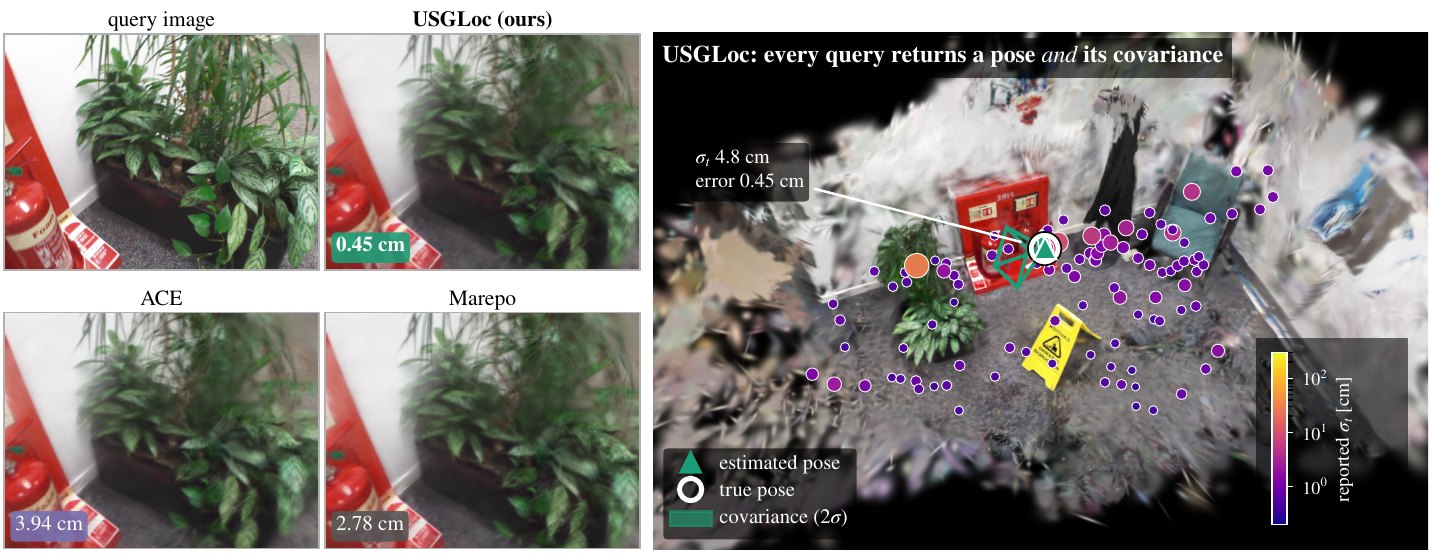
A visual localizer should tell a robot where the camera is and how much to trust that answer, because the pose is fused into a Bayesian state estimator. Recent semantic 3D Gaussian Splatting localizers are accurate but return a single pose with no confidence, while uncertainty-aware mapping methods quantify map reliability but do not localize.
USGLoc is an evidential localizer built on one principle: the map's own uncertainty drives every stage and survives to the output. Each primitive of an evidential semantic Gaussian map carries a Dempster–Shafer belief over open-vocabulary semantics with an explicit vacuity mass, and the query is encoded into the same space. Vacuity gates 2D–3D semantic matching, which turns retrieval ambiguity into a pose mixture; it gates the correspondences of a render-and-match correction; and it weights the rendering residual per pixel. A tempered Laplace approximation turns each refined hypothesis into a covariance, giving a Gaussian-mixture posterior on SE(3) that condenses to one Gaussian for a filter.
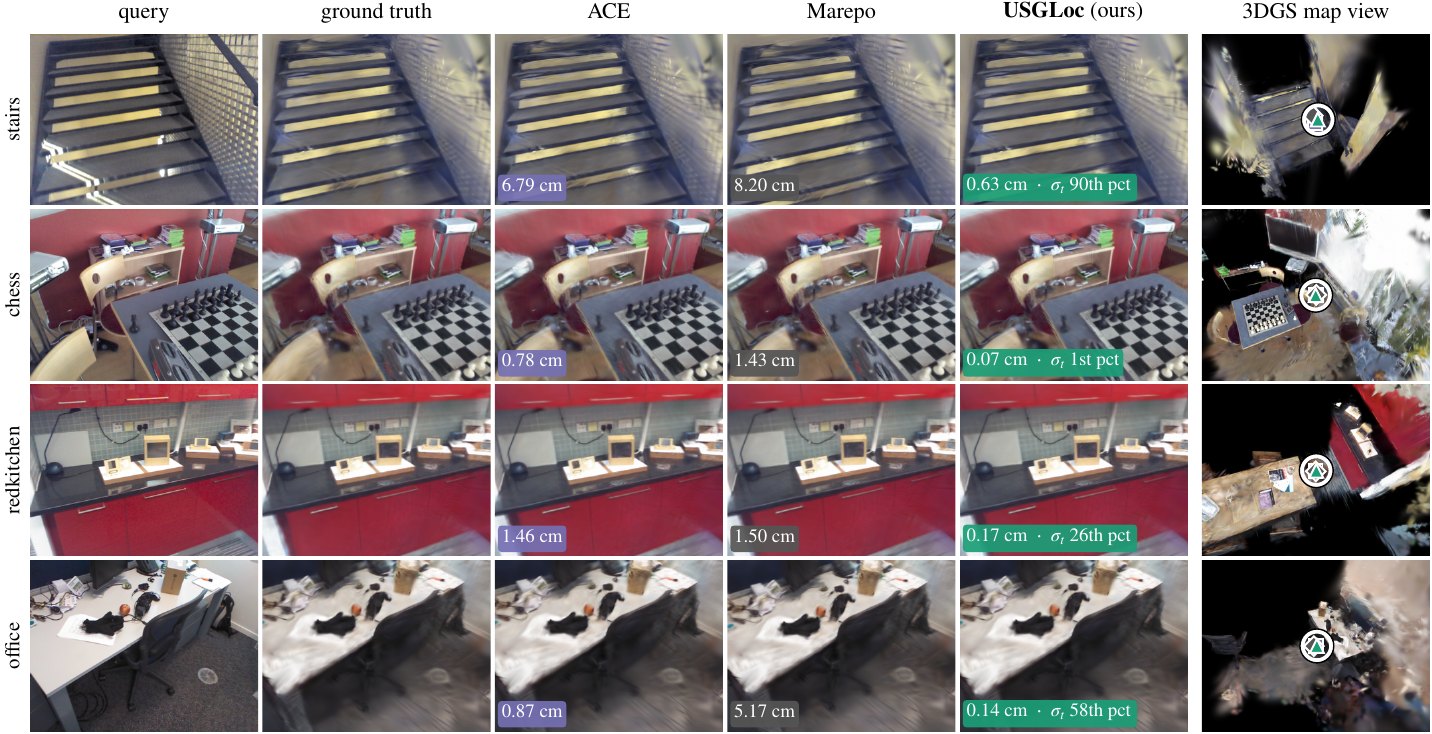
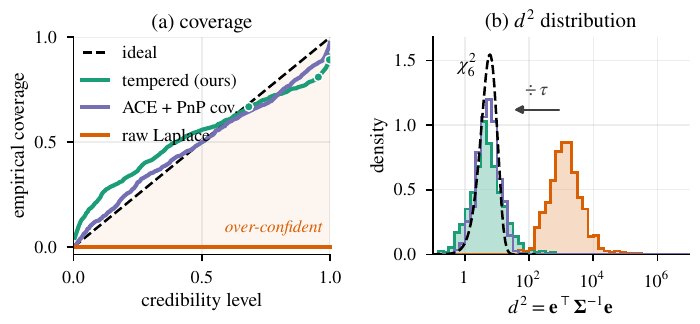
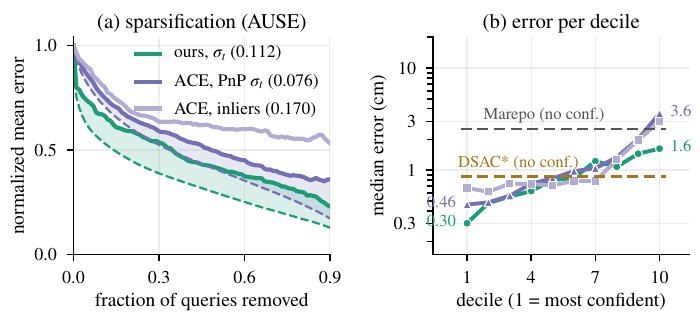
Without an external pose prior, USGLoc localizes to 0.83 cm / 0.26° on average on 7Scenes and 0.62 cm / 0.26° on 12Scenes. The poses it trusts most are the most accurate in the comparison: 0.30 cm on its most-confident tenth of 7Scenes queries, against 0.46 cm for a strong scene-coordinate baseline ranked by a PnP covariance. The tempered covariance is close to nominal at the 68% level and over-confident in the tails.
02 · Video
USGLoc in three minutes
03 · Method
Uncertainty from the map all the way to the pose
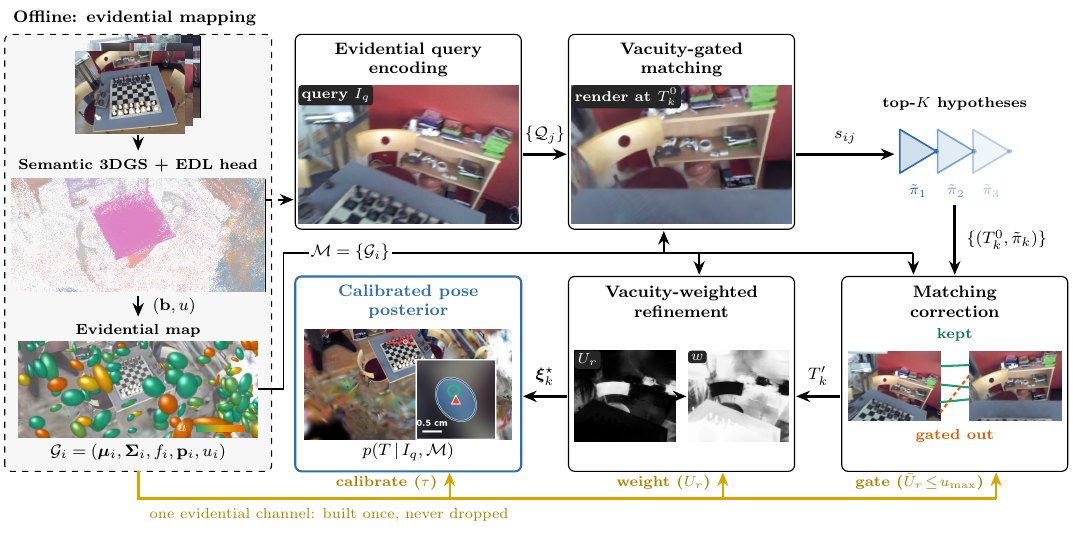
- 1
Evidential semantic map
Every Gaussian primitive stores geometry, a CLIP embedding and a Dempster–Shafer belief with an explicit vacuity mass ("I don't know").
- 2
Query in the same space
The query image is segmented (FastSAM) and encoded by the same evidential head, so map and query confidences share one scale.
- 3
Gated matching → pose mixture
Vacuity gates 2D–3D semantic matching; ambiguous retrievals become several pose hypotheses instead of one forced guess.
- 4
Render-and-match correction
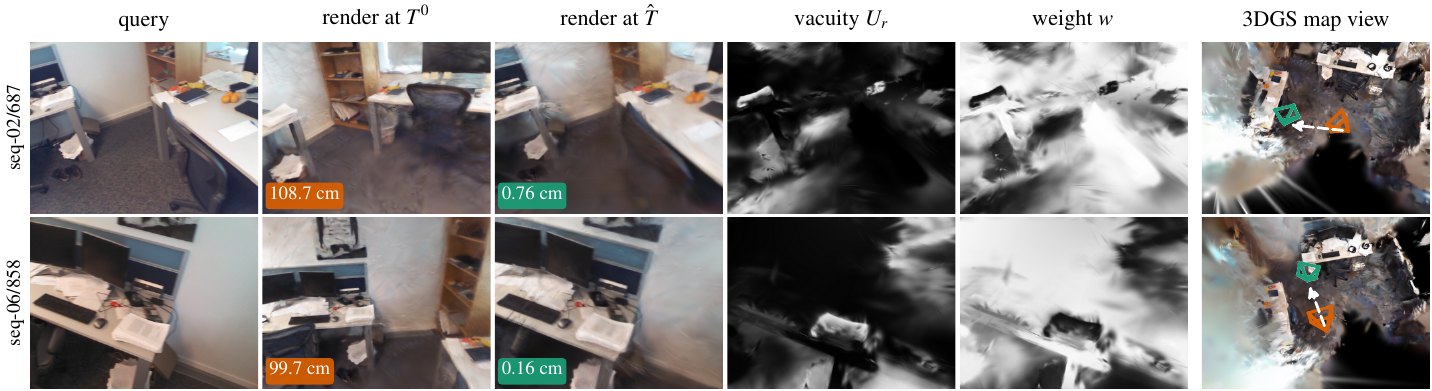
Each hypothesis is corrected by matching the query to renders of the map, with vacuity gating the correspondences.
- 5
Vacuity-weighted refinement
The rendering residual is weighted per pixel by vacuity, so unreliable map regions pull the pose less.
- 6
Calibrated covariance
A tempered Laplace approximation gives each refined hypothesis a covariance: a Gaussian mixture on SE(3) that condenses to one Gaussian for a filter.
04 · Accuracy
Localization on 7Scenes and 12Scenes
Median translation and rotation error under the SfM pseudo ground truth, and success rates. Pick a dataset, a scene and a metric.
05 · Trust
The poses it trusts most are the most accurate
Selective localization on 700 7Scenes queries: keep only the most-confident fraction and report the median translation error of what is kept. Methods without a confidence cannot improve.
06 · Ablation
Which parts matter
Each row removes one component from the full model on earlier maps (Chess and Stairs, 100 queries each). Bars show the success rate at 5 cm / 5°.
The render-and-match correction is essential: without it, success on Stairs drops from 58% to 6%. Runtime: about 12 s per query on an RTX 4070 Ti, 78% of it in the matching correction, so USGLoc is not yet real-time.
07 · Cite
Citation
@misc{canh2026usgloc,
  title  = {USGLoc: Uncertainty-Aware Semantic Visual Localization from 3D Gaussian Splatting},
  author = {Canh, Thanh Nguyen and HoangVan, Xiem and Chong, Nak Young},
  note   = {Preprint, under review},
  year   = {2026}
}