
Preprint 2026
CPOR-Grasp
Calibrated probabilistic obstruction reasoning with vision-language models for grasping in clutter
1VNU University of Engineering and Technology 2Japan Advanced Institute of Science and Technology 3Hanyang University *Corresponding author
01 · Abstract
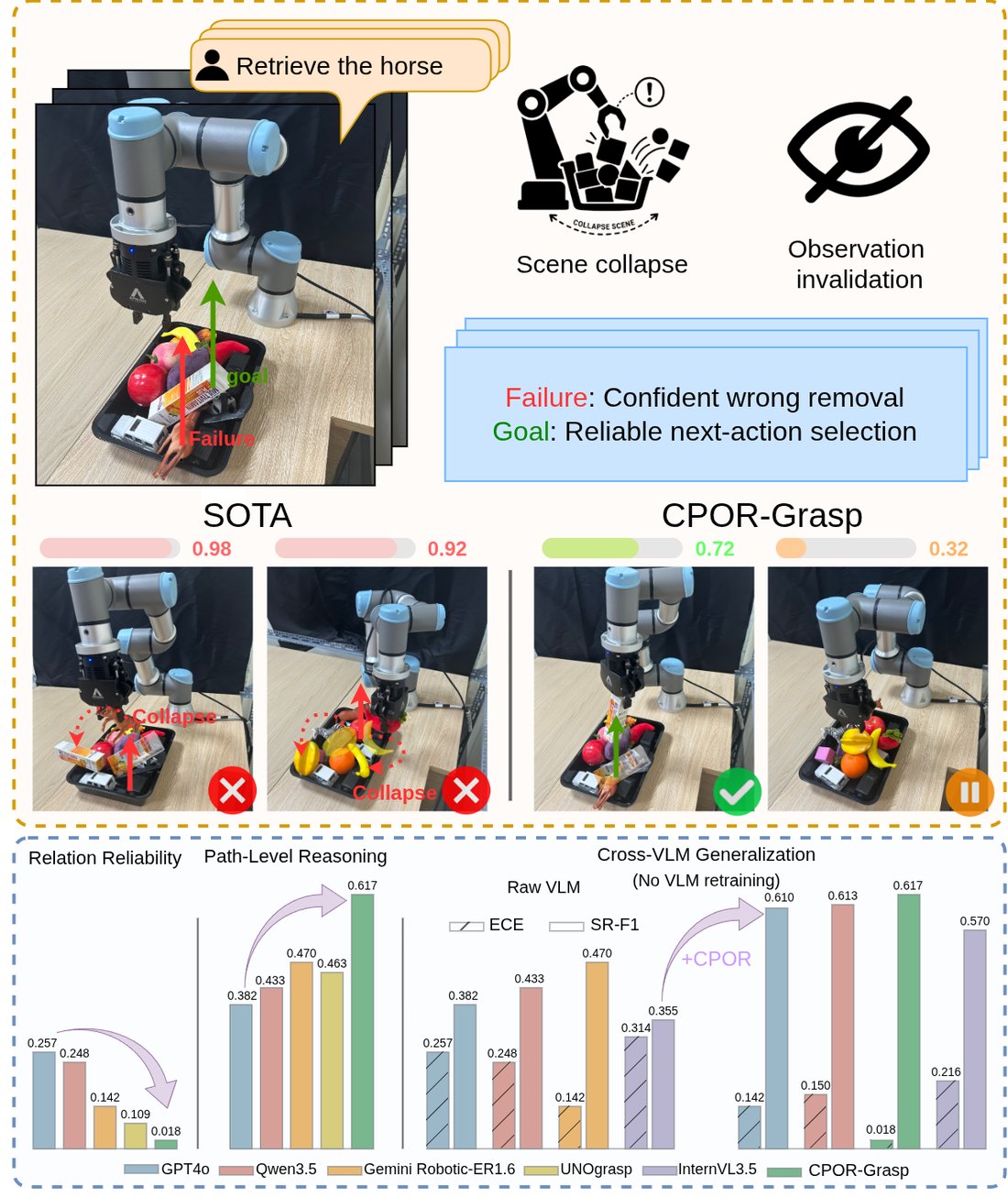
Grasp the target, remove a blocker, or defer?
Retrieving a target from clutter requires deciding whether to grasp the target, remove a blocker, or defer. Existing methods typically commit to a single obstruction graph or removal strategy, ignoring uncertainty across alternative scene interpretations. They rely on miscalibrated vision-language model (VLM) predictions, can produce pairwise obstruction relations that are jointly inconsistent, and give no guarantee about how discarded hypotheses affect the final decision.
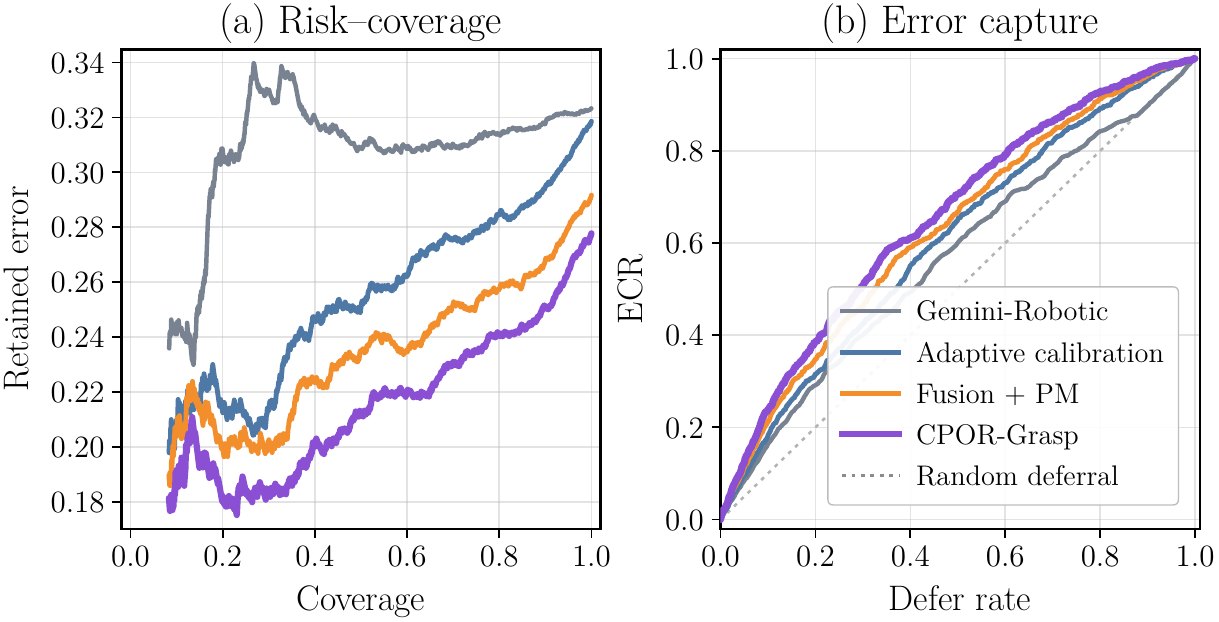
CPOR-Grasp propagates uncertainty from pairwise evidence to action decisions. It calibrates and fuses VLM, depth and amodal-mask cues into obstruction probabilities, induces a distribution over valid obstruction graphs, and marginalizes over them to estimate whether the target is graspable or a blocker should be removed. To stay tractable it keeps only the highest-probability graphs and derives a total-variation bound on the discarded mass, enabling certified decisions, adaptive stopping and principled deferral.
On synthetic and real UNOBench scenes CPOR-Grasp outperforms state-of-the-art baselines on most metrics; the explorer below shows each one, including where a baseline is better. On a UR3 robot it reaches a 77.8% average success rate.
02 · Video
CPOR-Grasp on a real robot
03 · Method
From pairwise evidence to a certified next action
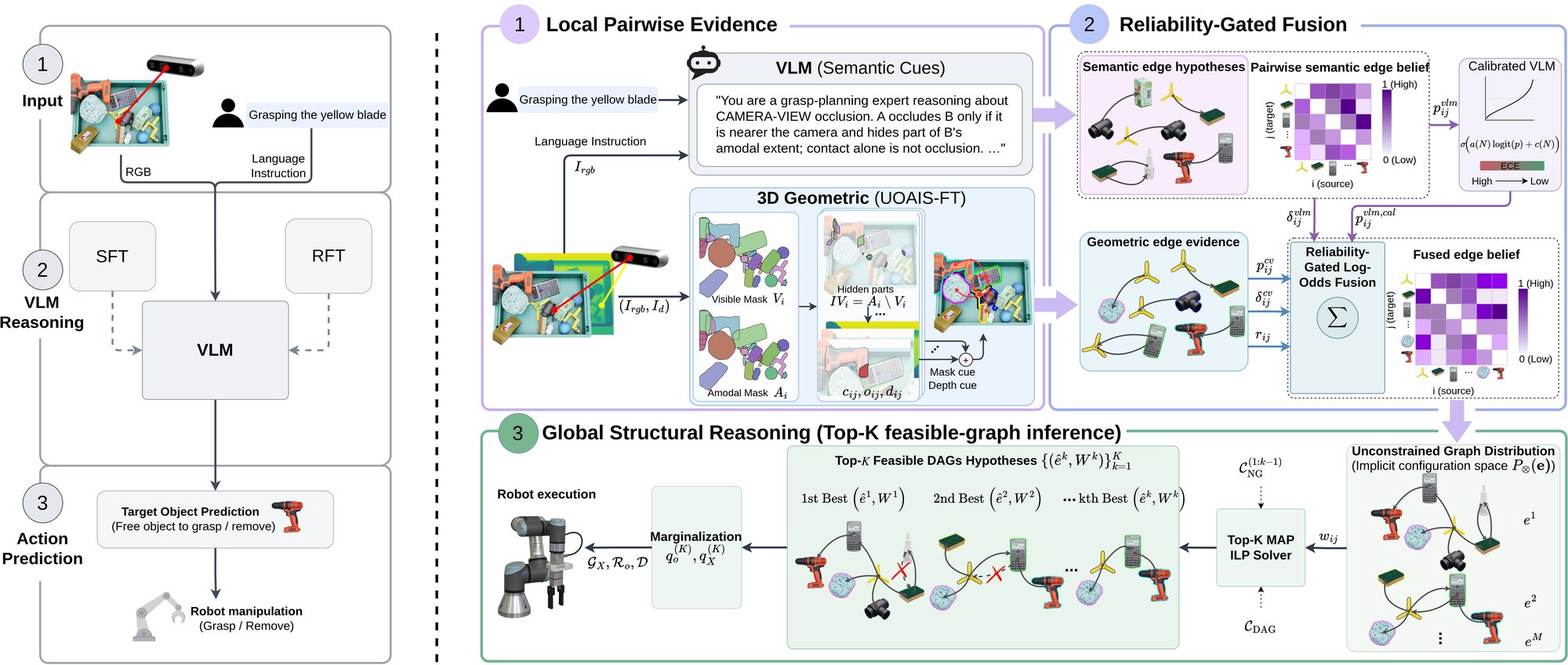
- 1
Local pairwise evidence
A VLM scores directed obstruction relations from the image and the request; fine-tuned UOAIS amodal masks and depth give geometric evidence for the same relations.
- 2
Calibration
Each source's confidence is calibrated with scene-conditioned (adaptive) Platt scaling, fit once on synthetic data and never refit per domain.
- 3
Reliability-gated fusion
Calibrated sources are fused in log-odds space, discounting unreliable evidence, into one probability per directed obstruction relation.
- 4
Posterior over graphs
The relations induce a distribution over obstruction graphs that admit a removal order (acyclic), instead of a single committed graph.
- 5
Certified Top-K inference
Only the K most probable graphs are kept; a per-scene total-variation bound certifies when the truncated decision equals exact inference.
- 6
Act or defer
Marginals give the probability that the target is free or a blocker should go; the robot grasps, removes, or defers, then FGC-GraspNet plans the 6-DoF grasp.
04 · Results
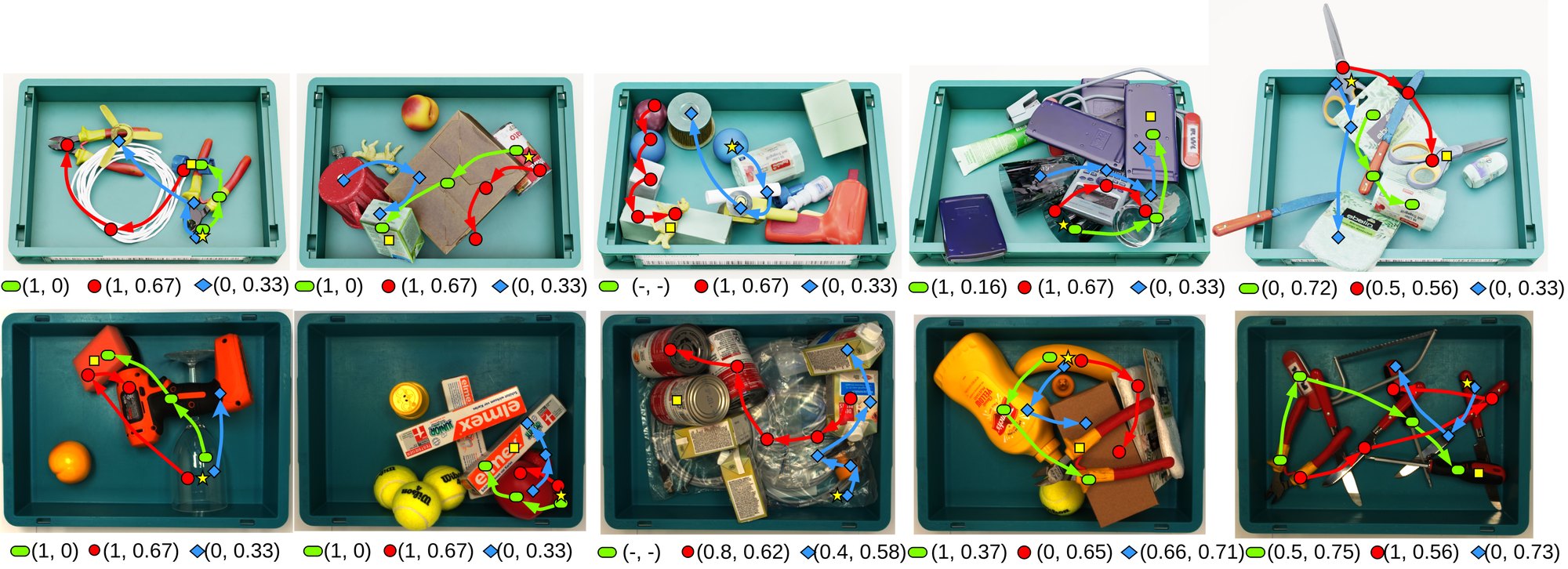
Obstruction reasoning on UNOBench
Pick a task, split, difficulty tier and metric. Path-level reasoning scores the predicted removal path; next-obstructor prediction scores the object to remove first.
05 · Calibration
Probabilities you can act on
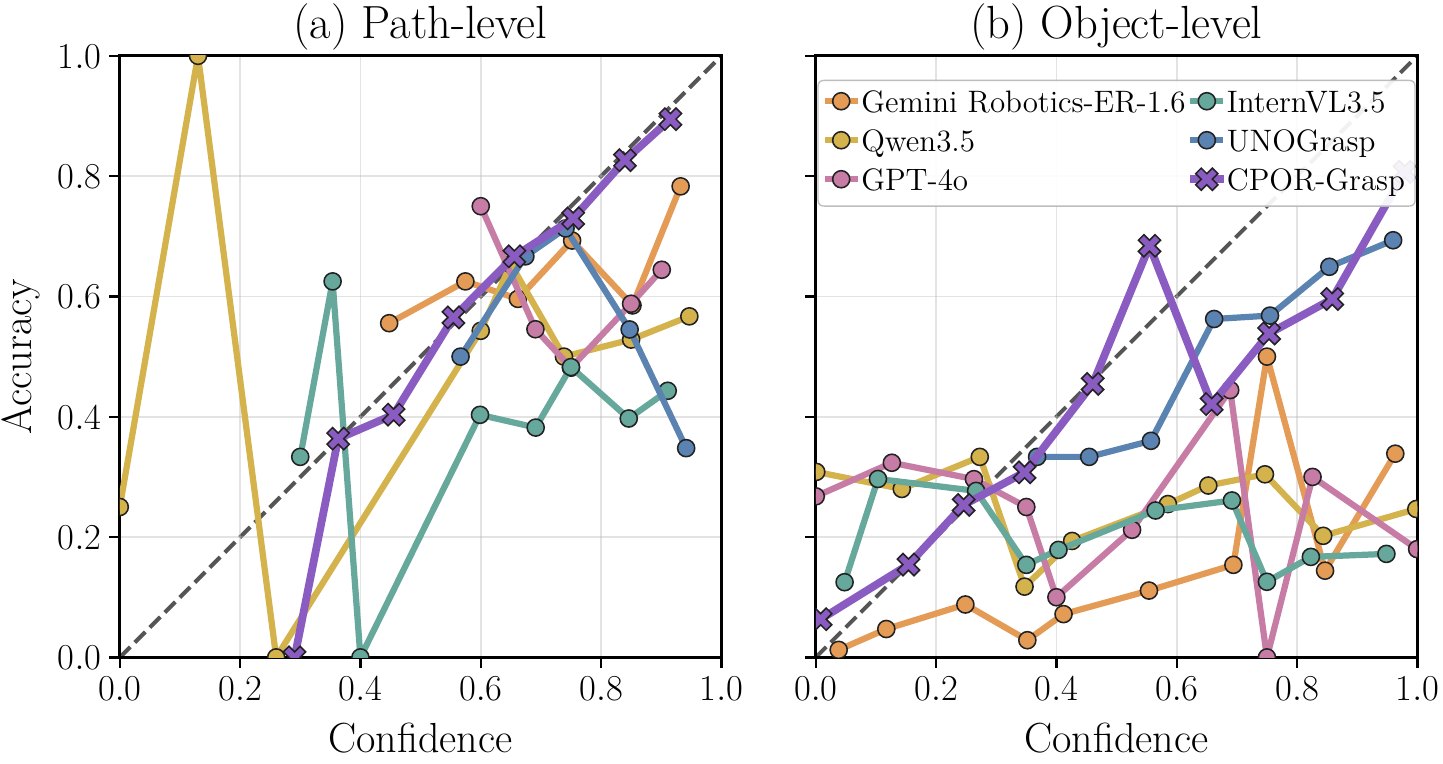
Works across VLMs, without retraining
06 · Certified inference
Top-K graphs with a guarantee
Exact enumeration over all order-feasible graphs is expensive. Keeping the K most probable graphs is fast, and the total-variation bound tells when the truncated decision is certified to match exact inference; otherwise K grows adaptively.
07 · Real robot
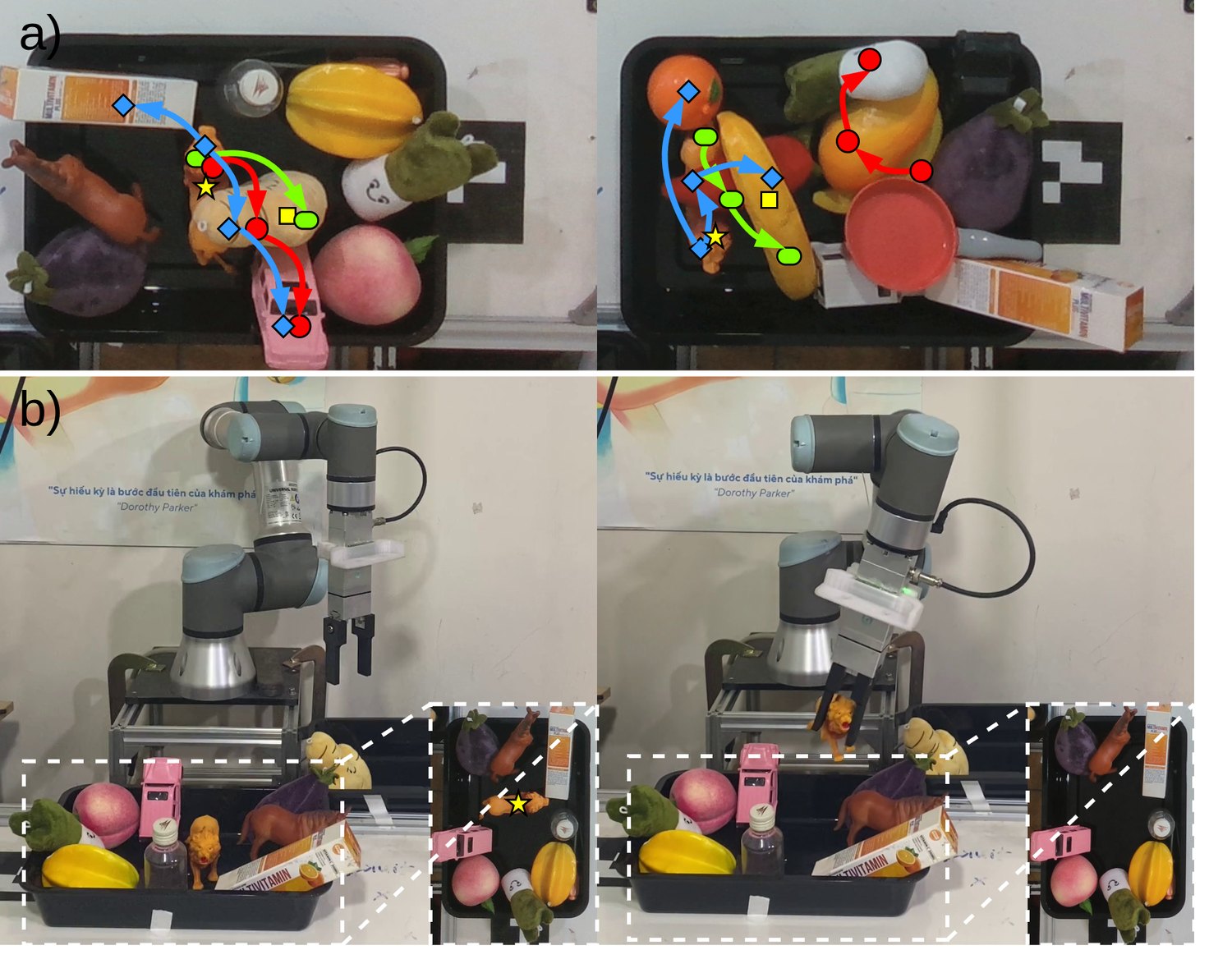
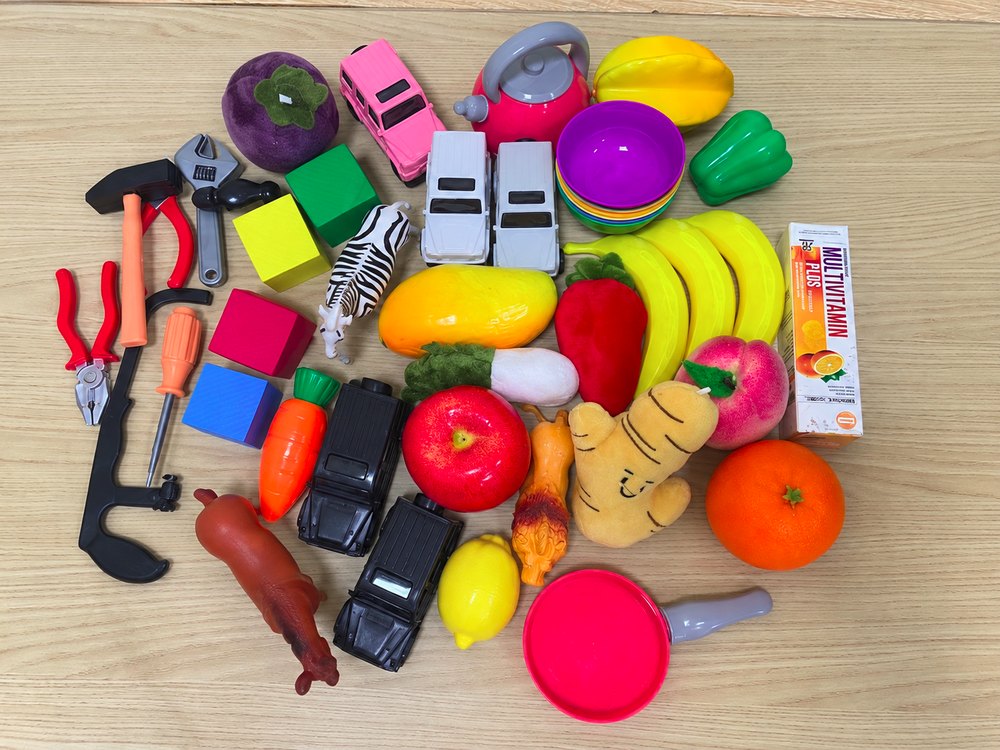
UR3, 45 paired scenarios, 40 objects
CPOR-Grasp, UNOGrasp and Gemini Robotics-ER-1.6 run on matched scenes with the same grasping backend and action budget. Success needs the correct blocker removal and target retrieval within the budget.
08 · Cite
Citation
@misc{tran2026cporgrasp,
  title         = {{CPOR-Grasp}: Calibrated Probabilistic Obstruction Reasoning with Vision-Language Models for Grasping in Clutter},
  author        = {Tran, Thanh-Tuan and Chu, Ngoc-Chien and Canh, Thanh Nguyen and Chong, Nak Young and Ha, Nguyen Viet and HoangVan, Xiem},
  eprint        = {2609.18718},
  archivePrefix = {arXiv},
  year          = {2026}
}