
Preprint 2026
Spatio-Temporal Semantic Mapping
Efficient continuous semantic mapping based on spatio-temporal awareness
1VNU University of Engineering and Technology, Hanoi 2Japan Advanced Institute of Science and Technology
01 · Abstract
Infer where it is uncertain, remember for as long as it matters
Reliable continuous semantic mapping must integrate noisy LiDAR observations while keeping the map spatially accurate and temporally consistent. Existing methods often use a fixed spatial support, or accumulate semantic evidence without accounting for elapsed time, which wastes computation and leads to inconsistent labels.
We propose an uncertainty- and time-aware framework that combines adaptive spatial inference with temporal semantic fusion. Normalized Shannon entropy sets each voxel's kernel length: wider neighborhoods where the labels are uncertain, narrower ones where they are confident. An elapsed-time-dependent decay weights historical evidence across successive scans.
On SemanticKITTI sequences 03–06 the framework has the highest overall accuracy and weighted IoU of the evaluated methods. On sequence 03 it reaches 54.92% mIoU, 13.18 points above spatial-only inference, and the adaptive kernel is both more accurate and faster than every fixed kernel tested.
02 · Method
Adaptive spatial inference, then time-aware fusion
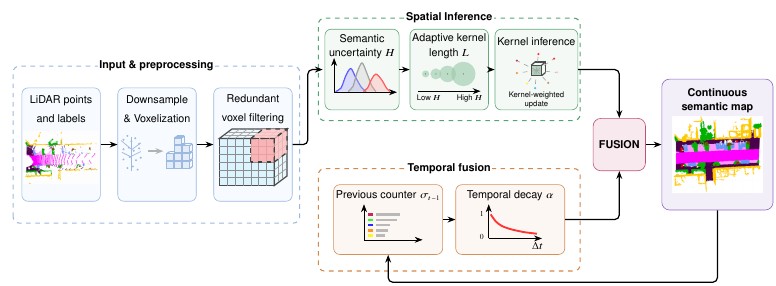
- 1
Preprocessing
LiDAR points with semantic labels are downsampled, voxelized in an octree, and redundant voxels are filtered out.
- 2
Semantic uncertainty
Normalized Shannon entropy H̄(v) ∈ [0, 1] of each voxel's class distribution, using all competing classes, not only the top one.
- 3
Adaptive kernel length
L(v) grows linearly with H̄(v): confident voxels use a small neighborhood, ambiguous ones gather more context.
- 4
Kernel inference
A compactly supported kernel accumulates per-class evidence from nearby points; points outside the support do not contribute.
- 5
Time-aware fusion
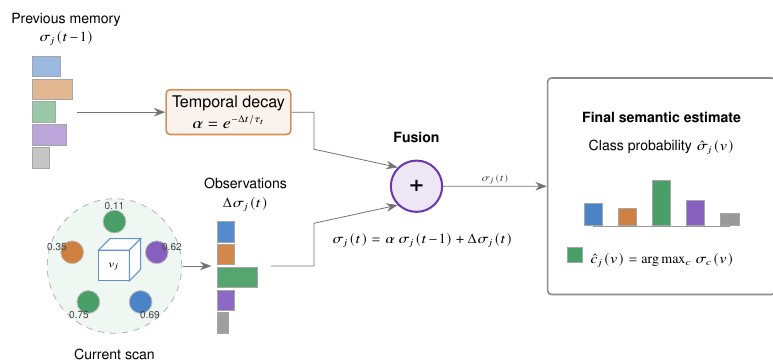
The per-voxel counter is updated as σt = α σt−1 + Δσt, with α = e−Δt/τ set by the time since the last update.
- 6
Label
Counters are normalized into class probabilities, and each voxel takes the most probable class.
03 · Temporal decay
How much does old evidence still count?
The decay factor α = e−Δt/τ (Eq. 6, Fig. 2) weights the previous counter. A larger time constant τ keeps old information longer; a smaller one forgets faster. Move the sliders.
The paper's Fig. 2 shows τ = 0.4, 1 and 3.
04 · Results
SemanticKITTI sequences 03–06
Compared with count-and-smooth mapping (CSM) and spatial Bayesian kernel inference (S-BKI). Pick a sequence and a metric or class.
The gains are not universal: on sequence 05, sidewalk IoU is lower than both baselines, as the paper notes.
05 · Adaptive kernel
More accurate and faster than any fixed kernel
Runtimes refer to the 10-scan benchmark of the paper and are not a claim of real-time performance.
06 · Ablation
What temporal fusion adds
07 · Qualitative
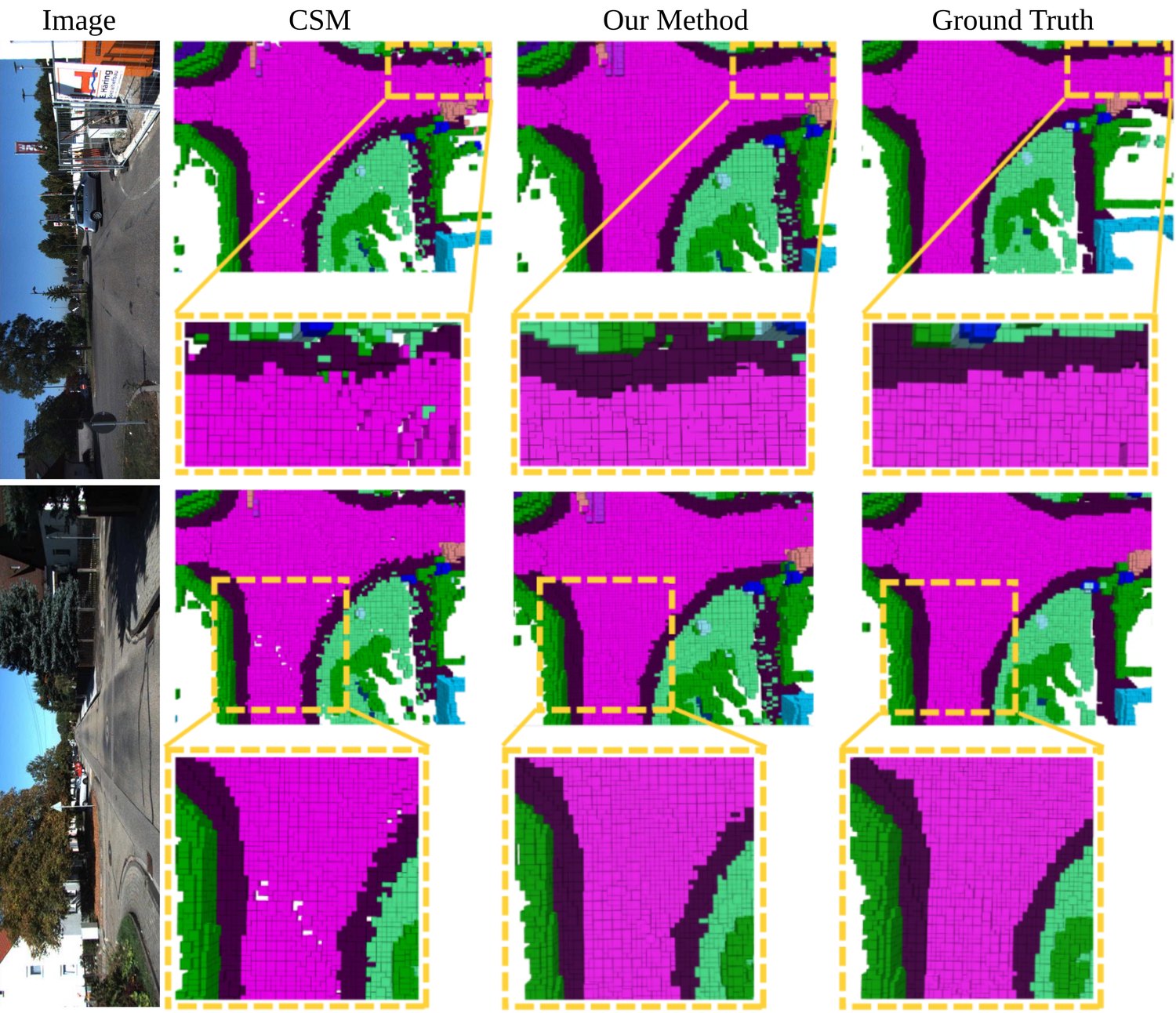
Semantic maps
Limitations stated in the paper: the method depends on the quality of the input segmentation and does not explicitly handle dynamic objects.
08 · Cite
Citation
@misc{pham2026spatiotemporal,
  title         = {Efficient Continuous Semantic Mapping based on Spatio-Temporal Awareness},
  author        = {Pham, My Le and Duong, Dinh Trieu and HoangVan, Xiem and Canh, Thanh Nguyen},
  eprint        = {2606.22672},
  archivePrefix = {arXiv},
  year          = {2026}
}