
Unified formulation
Semantic vSLAM as joint estimation of the robot trajectory, a geometric map and the semantic labels of its elements.
Survey Robotics and Autonomous Systems · Vol. 203 · 2026 · Open access
A survey on state of the art, challenges, and future directions
1Japan Advanced Institute of Science and Technology 2VNU University of Engineering and Technology 3Hanyang University *Corresponding authors
01 · Overview
Semantic visual SLAM localizes a robot and builds a map that also carries meaning: objects, classes and places. Although the first semantic SLAM systems appeared more than two decades ago, the field has lacked a survey that covers both its recent advances and its persistent problems.
This survey traces how visual SLAM evolved, critically reviews earlier surveys, and proposes a unified problem formulation. It then decomposes the problem into a five-stage modular pipeline, covers deep-learning, foundation-model, continuous-representation and multi-robot approaches, reviews datasets and metrics, and closes with open research questions.
Semantic vSLAM as joint estimation of the robot trajectory, a geometric map and the semantic labels of its elements.
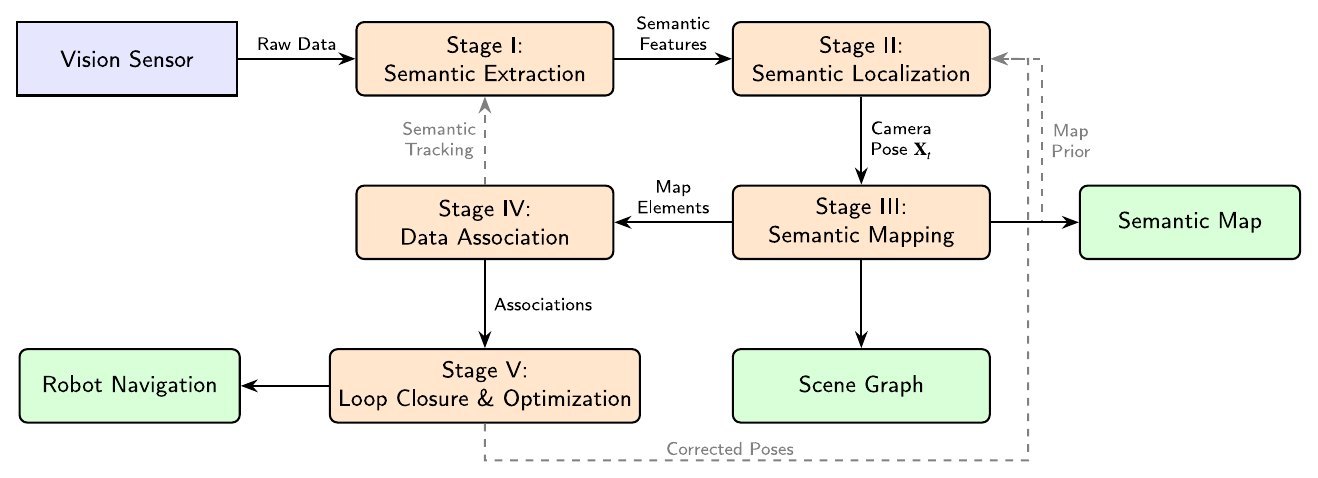
Five stages, from semantic extraction to loop closure, each compared across methods in its own table.
Learning-based, foundation-model, NeRF/3DGS and multi-robot systems, plus the questions that remain open.
02 · Taxonomy
The survey organizes approaches by the coupling level between the geometric and semantic components.
Redrawn from Fig. 1 of the paper.
03 · Pipeline
Information flows forward from perception to optimization, and feedback loops let later stages refine earlier ones.
04 · Evolution
The 34 representative systems in Table 1 by year and family. Hover or tap a system to see its reference.
05 · Explorer
Filter Table 1 by family and capability, or search by name, sensor model or map type. Press / to search.
| System | Year | Family | SLAM approach | Perception | Map | Back-end | Dyn. | Open-voc. | Loop | Large | Code |
|---|
No system matches these filters.
06 · Compare
Tables 3–7 of the paper, one per pipeline stage.
07 · Open questions
08 · Cite
@article{canh2026semantic,
  title   = {Semantic Visual Simultaneous Localization and Mapping: A survey on state of the art, challenges, and future directions},
  author  = {Canh, Thanh Nguyen and Zhang, Haolan and HoangVan, Xiem and Chong, Nak Young},
  journal = {Robotics and Autonomous Systems},
  volume  = {203},
  pages   = {105535},
  year    = {2026},
  doi     = {10.1016/j.robot.2026.105535}
}