
Systematic review
Classical geometric, learning-enhanced and neural scene representations, and how each copes with colonoscopy's challenges.
Survey + benchmark Preprint · under review · 2026
Recent advances, benchmarking, and future perspectives
1VNU University of Engineering and Technology 2Japan Advanced Institute of Science and Technology 3College of Engineering and Computer Science, VinUniversity 4VinUni Center for AI Research *Corresponding authors
01 · Overview
Colonoscopy is the gold standard for colorectal cancer screening, but its narrow field of view limits spatial awareness, coverage assessment and lesion localization. Monocular visual SLAM can estimate the endoscope's motion and reconstruct the colon in 3D from standard video, with no extra hardware.
The colon is a hard place for SLAM: weak and repetitive texture, specular reflections, changing illumination and tissue deformation. This survey traces methods from classical feature-based and direct SLAM to learning-based, neural-rendering and deformation-aware systems, and adds the first unified benchmark of monocular vSLAM for colonoscopy: 13 methods re-run under one protocol on C3VDv1.
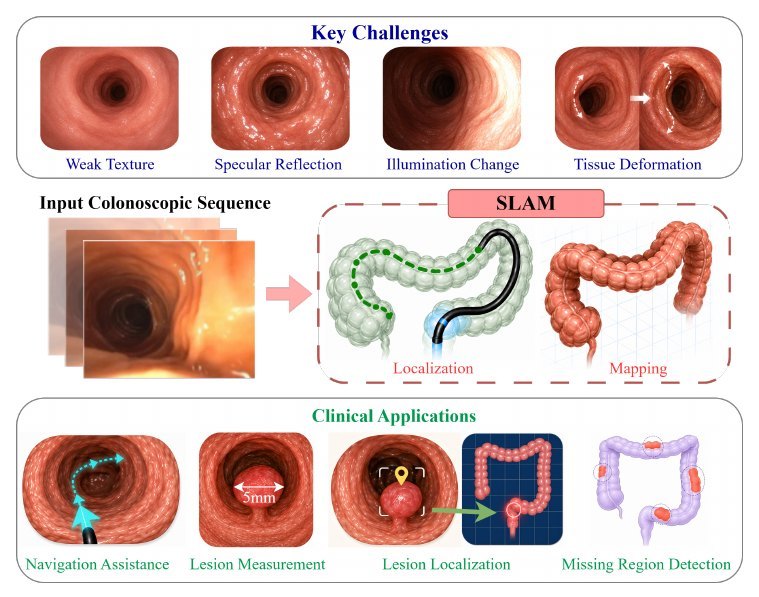
Classical geometric, learning-enhanced and neural scene representations, and how each copes with colonoscopy's challenges.
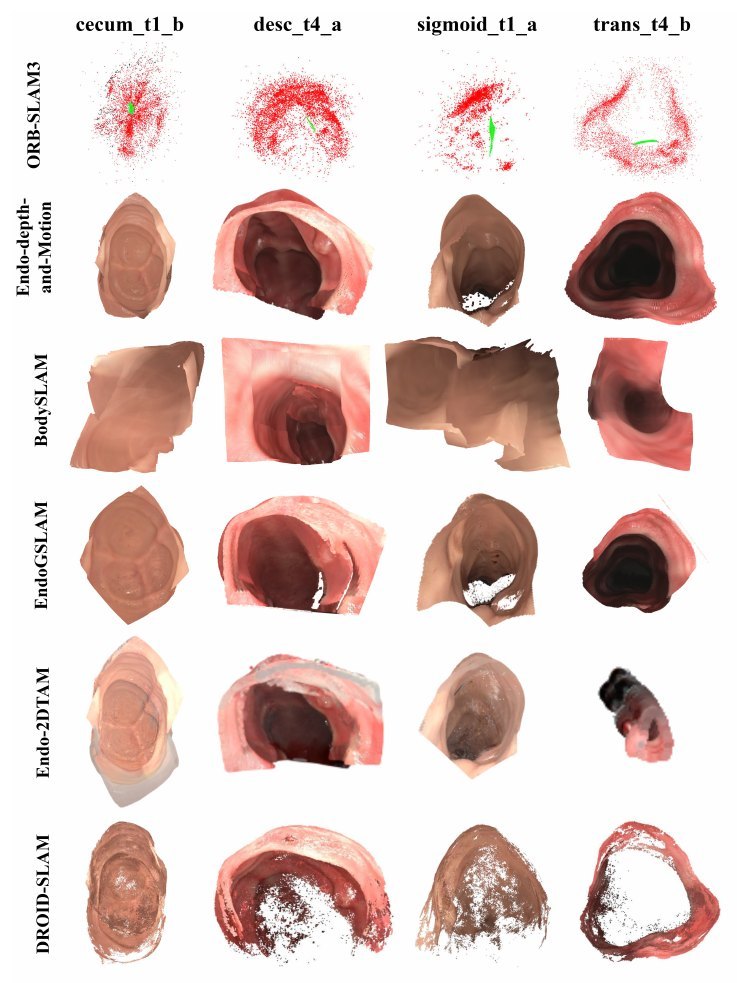
Representative methods re-implemented and evaluated on the same data, comparing accuracy, reconstructions and speed.
Dataset realism, evaluation protocols and workflow integration on the road to clinical deployment.
02 · Foundations
Feature-based SLAM minimizes reprojection error over matched keypoints; direct SLAM minimizes photometric error over image regions. Learning-based methods replace or strengthen parts of both.
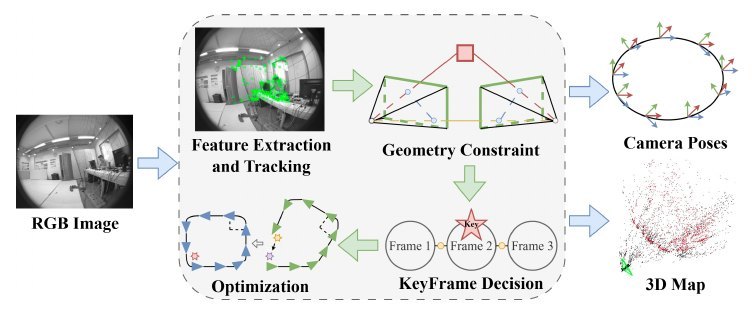
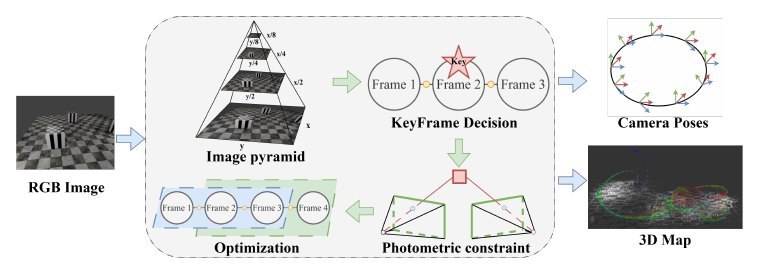
03 · Evolution
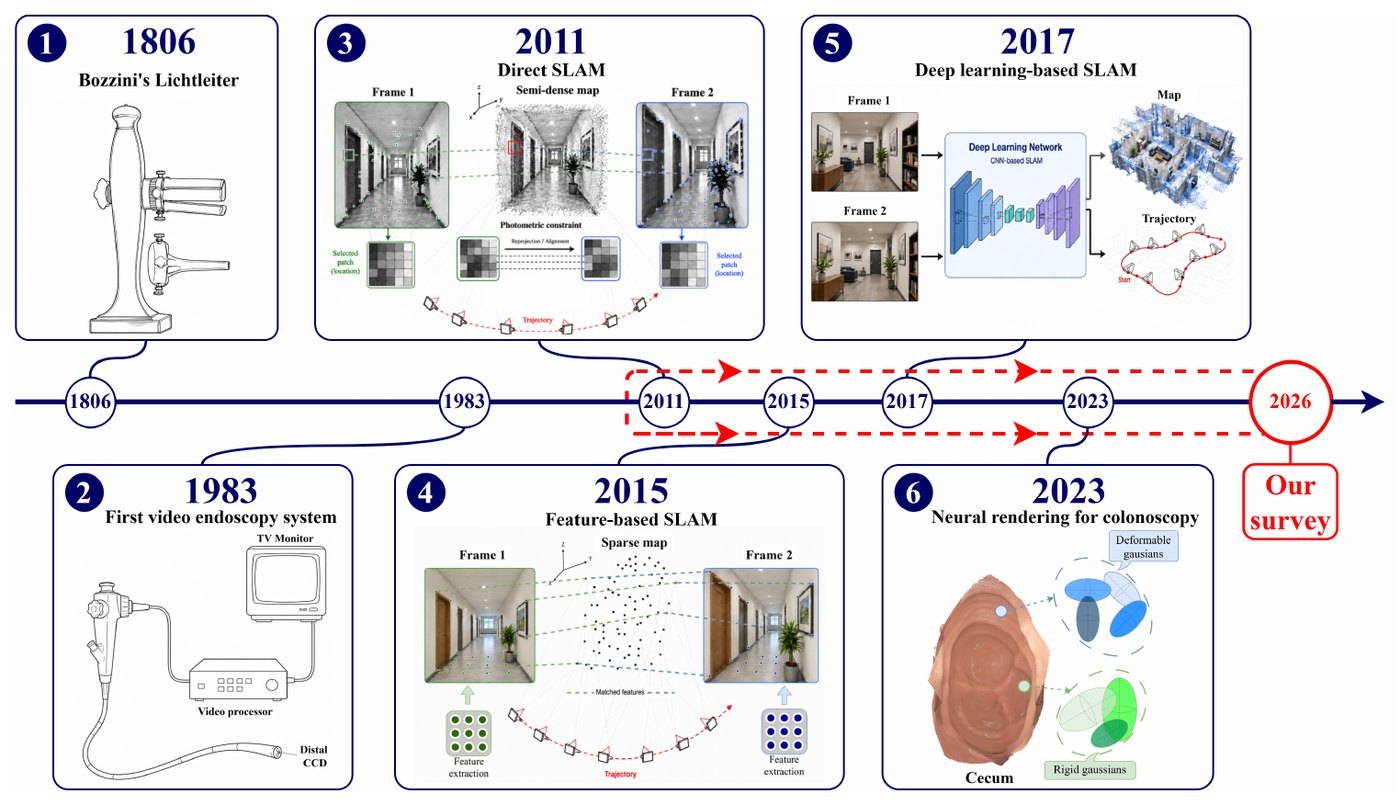
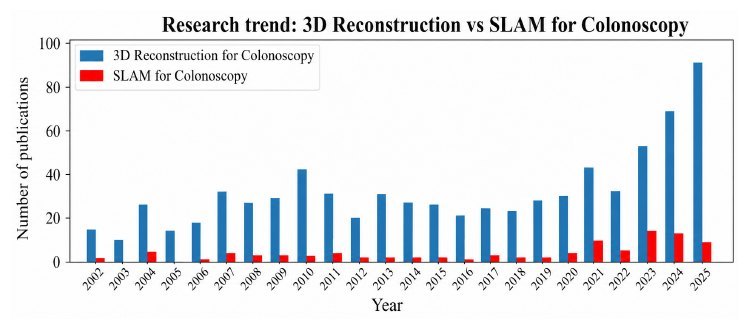
The 20 systems of Table 5 by year and family. Hover or tap for the reference; click to open it in the explorer.
04 · Explorer
Monocular vSLAM systems applied to, or applicable to, colonoscopy (Table 5). Press / to search; click a row for its reference.
| System | Year | Family | Domain | Map | Deformable | Needs depth | Real-time | Code |
|---|
No system matches these filters.
05 · Unified benchmark
Positional accuracy (ATE and RPE, mm) and speed on C3VDv1 (Table 8). Choose a segment and a metric.
Lesson 1
EndoGSLAM and Endo-2DTAM are strong on sigmoid_t1_a but degrade on desc_t4_a, and their maps become unstable when localization fails.
Lesson 2
In feature pipelines depth improves global alignment but not local motion; it must be coupled into tracking, and predicted depth needs explicit scale alignment.
Lesson 3
Current sequences cover short colon segments with slow motion, so they cannot test robustness over a full examination, motion blur or feature loss.
06 · Datasets
| Dataset | Type | Deformable | Year | Availability | Access | Depth GT | Trajectory GT | 3D map GT |
|---|
| Segment | Frames | Trajectory length (mm) |
|---|
07 · Open questions
08 · Cite
@misc{do2026monocular,
  title  = {Monocular vSLAM for Colonoscopy: Recent Advances, Benchmarking, and Future Perspectives},
  author = {Do, Duc Manh and Nguyen, Van Bang and Nguyen Canh, Thanh and Thai, Mai Thanh and HoangVan, Xiem},
  note   = {Preprint, under review},
  year   = {2026}
}