
Preprint 2026 · submitted
HiPer
Which objects stay? Learning hierarchical persistence beliefs for lifelong open-vocabulary object maps
1Japan Advanced Institute of Science and Technology 2Hanyang University *Corresponding author
01 · Abstract
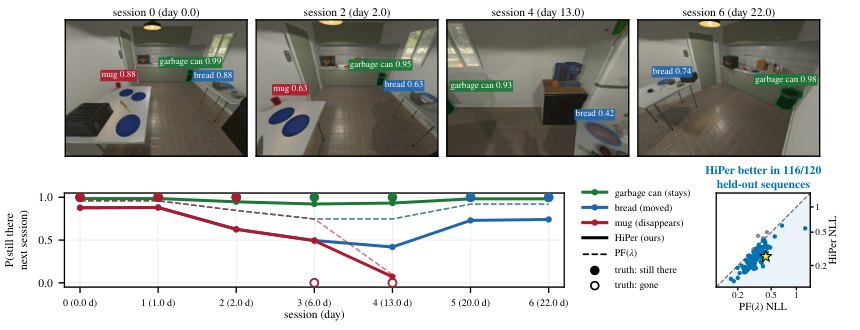
After an object leaves view, is it still there?
Lifelong object maps must estimate whether an object remains at its previously observed location after it leaves view. Existing persistence filters rely on class-based survival priors, which are hard to apply reliably in open-vocabulary settings.
We introduce HiPer, a hierarchical persistence filter that learns persistence beliefs from data rather than semantic categories. For a new object, HiPer retrieves visually and geometrically similar training instances and estimates an initial survival rate from their histories, with no class labels. This initializes a conjugate Beta belief over the object's survival probability, updated in closed form from detections and misses under Rosen's persistence-filter framework. When an object is re-identified at a new location, its belief moves with it, so the map learns object-specific mobility over time.
On 120 held-out simulated sequences HiPer performs best among the compared methods; retrieval-based priors beat CLIP-derived label priors, and object-specific online learning adds further gains. On 47 held-out 3RScan environments the retrieval prior also beats state-of-the-art baselines in real-world settings.
02 · Video
HiPer in three minutes
03 · Method
A belief per object, learned from similar objects
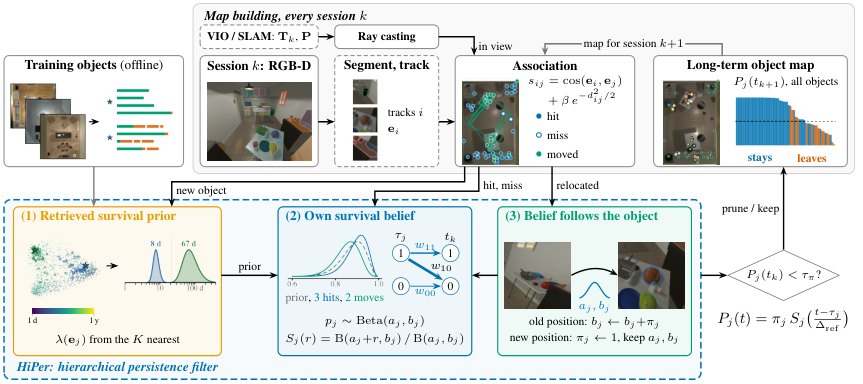
- 1
Cross-session association
Each session becomes one piece of evidence per map object: seen in place (hit), not seen (miss) or moved.
- 2
Survival prior by retrieval
A new object retrieves training instances similar in DINOv2 and CLIP appearance and in geometry, and inherits a survival rate from their persistence histories, without class labels.
- 3
Hierarchical persistence filter
A conjugate Beta belief over the object's survival rate is updated in closed form from hits and misses, inside Rosen's persistence filter.
- 4
Beliefs move with objects
When an object is re-identified somewhere else, its belief is transferred, so the map learns how mobile that specific object is.
- 5
Environment adaptation
An optional hazard multiplier, learned online from all objects in the map, rescales every survival model for environments busier or calmer than training.
- 6
Map maintenance
After each session, objects whose predicted probability of still being there falls below a threshold are removed from the map.
04 · Results
Persistence prediction on simulated and real data
Pick a dataset and a metric. NLL, Brier and ECE measure how good the predicted probabilities are (lower is better); AUC measures how well stayed and moved objects are separated (higher is better).
05 · Qualitative
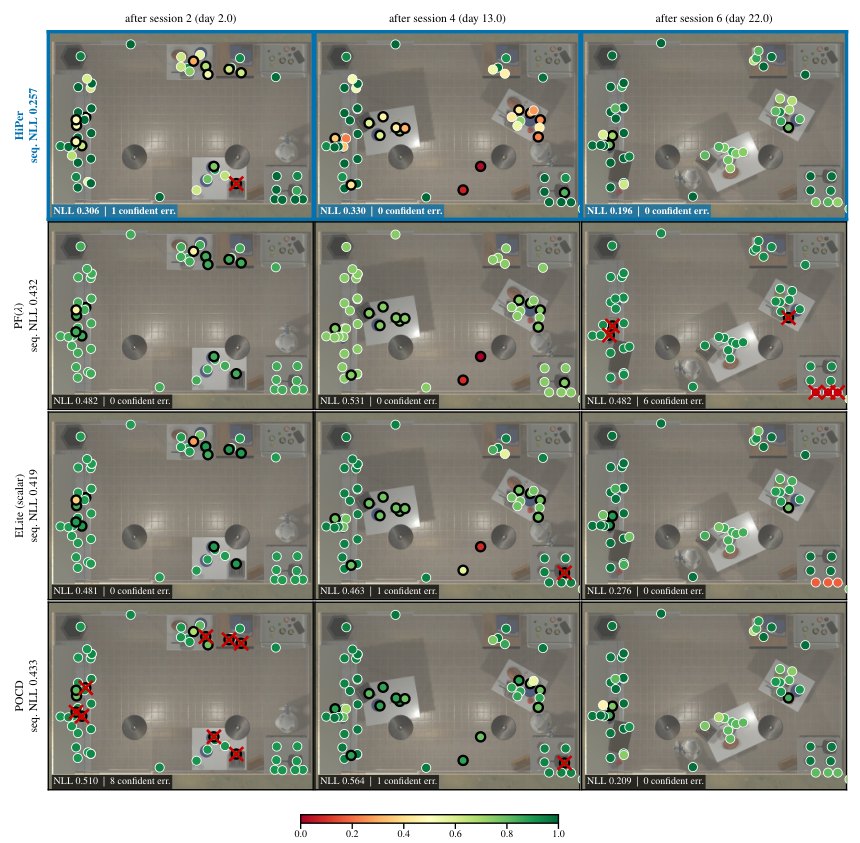
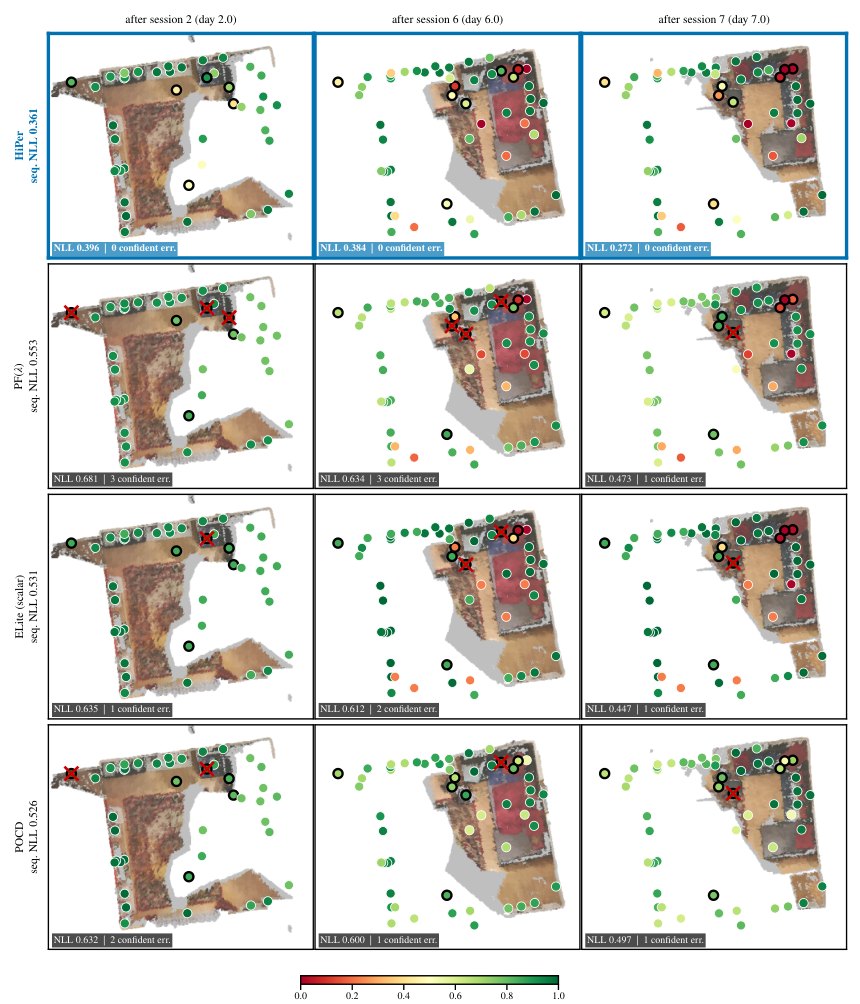
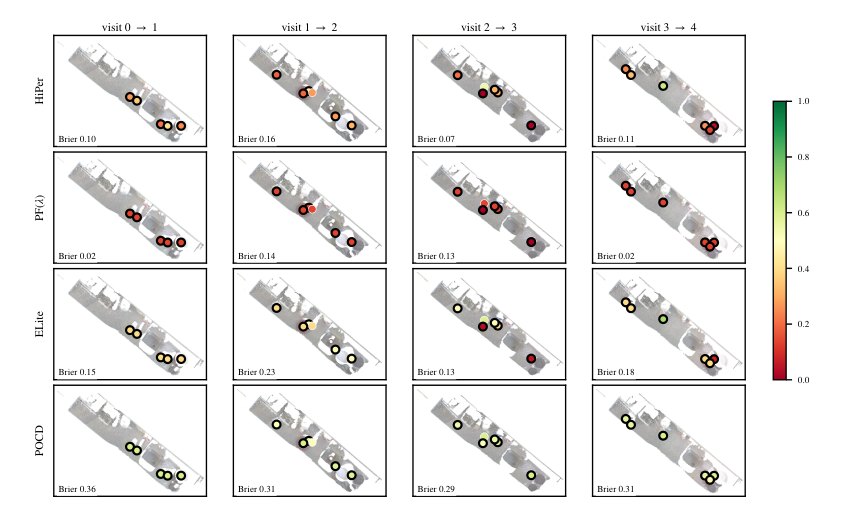
What the maps look like
06 · Ablation
Which parts matter
On THOR, replacing the retrieved prior with a hand-set class table and dropping appearance from association hurt the most; a single pooled rate and CLIP class rates also lose accuracy. Switch to 3RScan to compare.
07 · Cite
Citation
@misc{canh2026hiper,
  title         = {Which Objects Stay? Learning Hierarchical Persistence Beliefs for Lifelong Open-Vocabulary Object Maps},
  author        = {Canh, Thanh Nguyen and Zhang, Haolan and Chong, Nak Young},
  eprint        = {2611.07662},
  archivePrefix = {arXiv},
  year          = {2026}
}