
RA-L 2026 IEEE Robotics and Automation Letters · Vol. 11, No. 10
BPDA-GMM
Bayesian Probabilistic Data Association via Gaussian Mixture Models for Semantic SLAM
1Japan Advanced Institute of Science and Technology 2DIBRIS, University of Genoa 3VNU University of Engineering and Technology 4Hanyang University
01 · Abstract
Is this an object already in the map, or a new one?
Probabilistic data association (PDA) improves semantic SLAM in perceptually aliased scenes, but existing methods often assume a fixed landmark set, recompute association weights as the map grows, or rely on hand-tuned null-hypothesis weights.
We propose BPDA-GMM, an online Bayesian PDA framework for semantic SLAM with a growing object-level map. A Dirichlet-process prior induces a Chinese Restaurant Process (CRP) association model: accumulated evidence favors existing landmarks, and the concentration parameter reserves probability for new ones. Each detection is gated semantically and geometrically, assigned CRP-weighted association probabilities, and fused into semantic Gaussian landmarks in closed form. The landmarks form a Gaussian mixture whose dominant component enters the back-end as a max-mixture factor. When weights are inconclusive, ambiguity-triggered α-divergence tempering sharpens them, and a decoupled back-end lets noisy detections refine landmarks without perturbing the trajectory.
Experiments in simulation and on a real indoor dataset show better trajectory accuracy, semantic mapping quality and robustness to perceptual aliasing and classifier errors than state-of-the-art baselines.
02 · Video
BPDA-GMM in five minutes
03 · Method
From one detection to a consistent object map
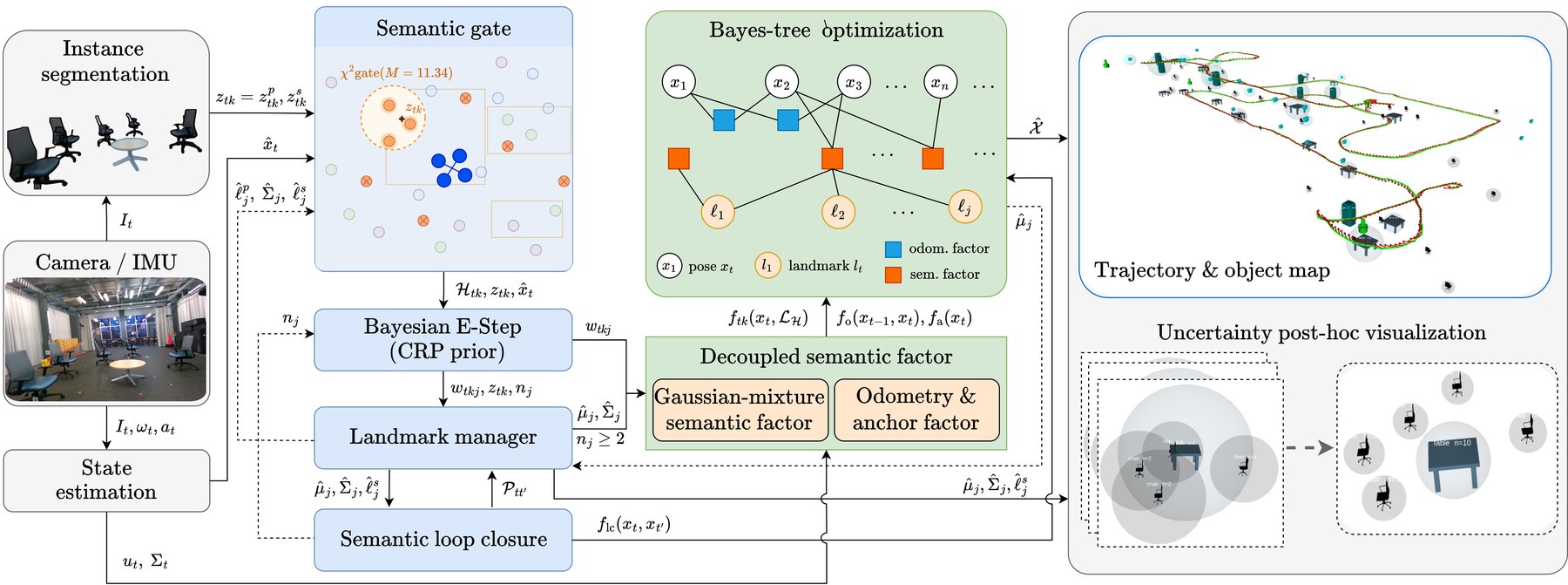
- 1
Semantic–geometric gate
Only landmarks that are close in space and plausible in class survive as candidates for a detection.
- 2
CRP association weights
A Dirichlet-process prior weighs existing landmarks by accumulated evidence and keeps a principled chance for a new landmark, with no hand-tuned null weight.
- 3
Semantic Gaussian update
Each landmark is a Gaussian over position and class, updated in closed form; together they form a Gaussian mixture map.
- 4
Tempering when ambiguous
If association weights are inconclusive, α-divergence tempering sharpens them instead of committing to a guess.
- 5
Decoupled back-end
The dominant component becomes a max-mixture factor whose pose Jacobian is zeroed, so noisy detections refine landmarks without bending the trajectory.
- 6
CRP loop closure
Re-identifying landmarks with the same CRP model closes semantic loops on revisits.
04 · Simulation benchmark
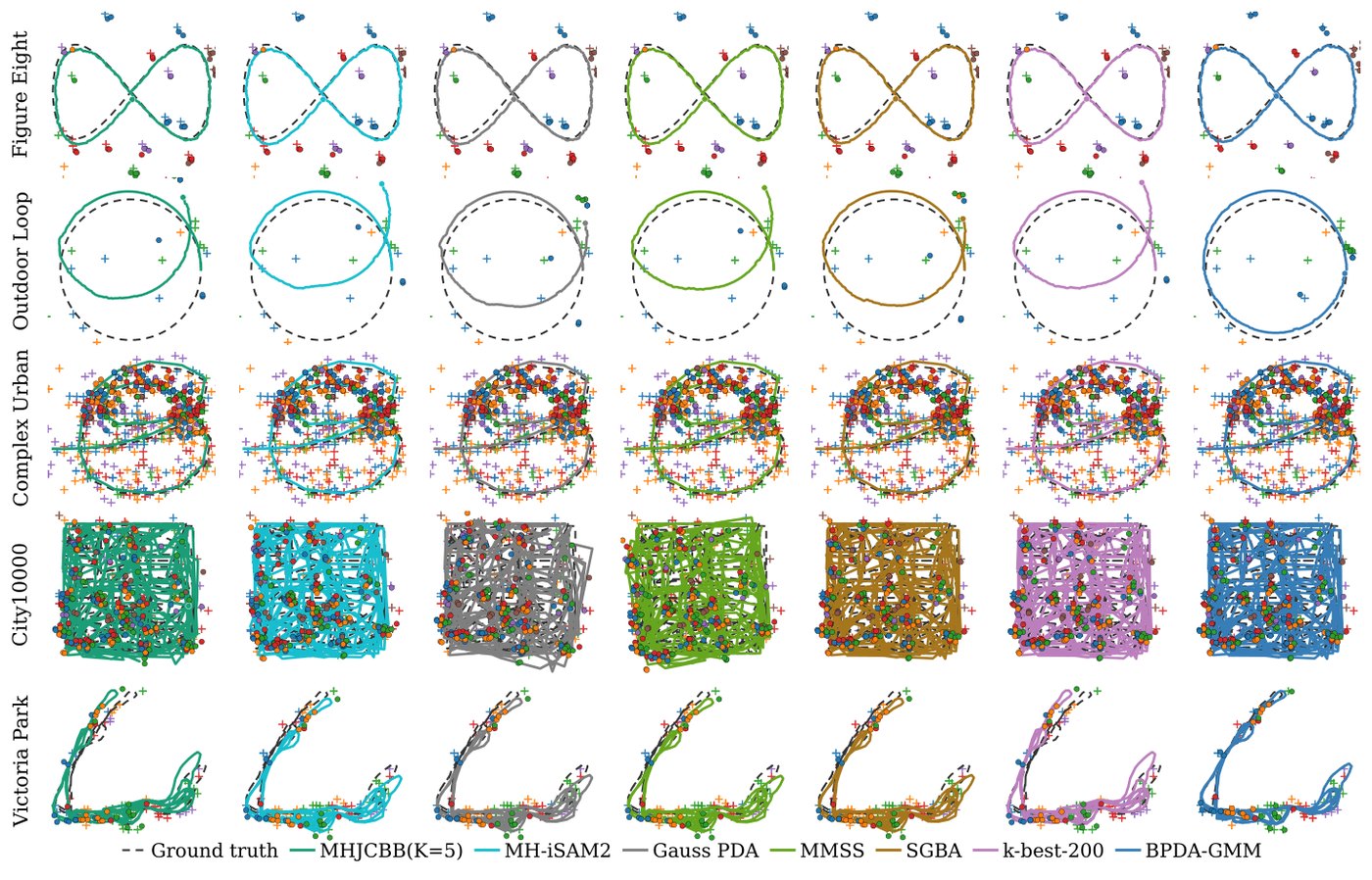
Five scenarios, seven methods
From a small figure-eight to Victoria Park with 151 landmarks. Pick a scenario and a metric; the chart and table update together.
05 · Real indoor dataset
Fewer duplicate objects, more correct ones
Object-level map quality on a real indoor sequence with 84 ground-truth objects in five classes (chair, table, monitor, fridge, plant).

06 · Analysis
Fast, and every part matters
07 · Cite
Citation
@article{canh2026bpdagmm,
  title   = {Bayesian Probabilistic Data Association via Gaussian Mixture Models for Semantic SLAM},
  author  = {Canh, Thanh Nguyen and Zhang, Haolan and Sgorbissa, Antonio and HoangVan, Xiem and Chong, Nak Young},
  journal = {IEEE Robotics and Automation Letters},
  volume  = {11},
  number  = {10},
  pages   = {11378--11385},
  year    = {2026},
  doi     = {10.1109/LRA.2026.3726389}
}