
Architecture taxonomy
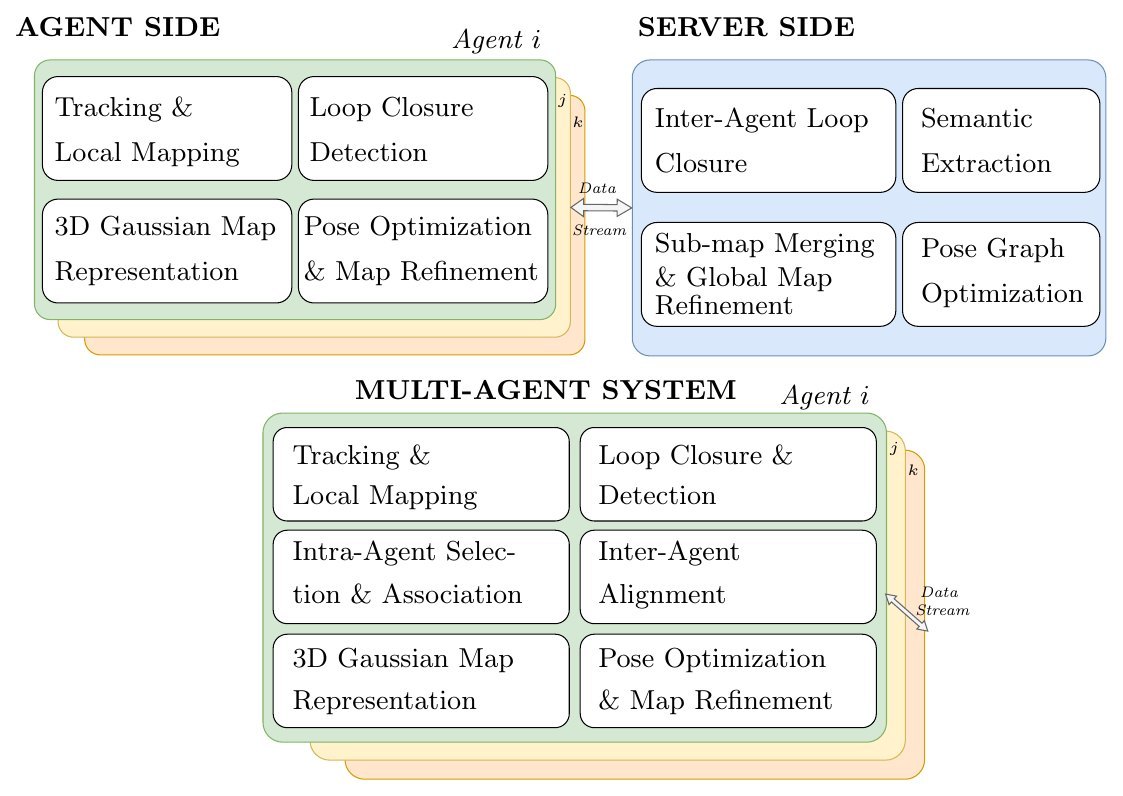
Centralized designs, which still dominate because of 3DGS compute and sync demands, versus emerging distributed ones.
Survey Preprint · under review · 2026
Architectures, methods, and future directions
1Institute of System Integration, Le Quy Don Technical University 2Japan Advanced Institute of Science and Technology 3AI and Data Science Research Center, Le Quy Don Technical University 4Hanyang University 5VNU University of Engineering and Technology †Equal contribution *Corresponding author
01 · Overview
Multi-robot SLAM needs a scene representation that is real-time, high-fidelity and easy to fuse across agents. Sparse feature maps and neural implicit fields each miss one of these. 3D Gaussian Splatting renders explicit Gaussian primitives by differentiable rasterization, so it is both fast and photorealistic, but its dense submaps strain bandwidth and must stay consistent across agents.
This survey reviews Collaborative Gaussian Splatting SLAM (CoGS-SLAM): systems that build a shared Gaussian map across robot teams. It proposes an architecture-based taxonomy, analyses four core problems, identifies cross-cutting design patterns, compares systems on common benchmarks and sets out open questions.
Centralized designs, which still dominate because of 3DGS compute and sync demands, versus emerging distributed ones.
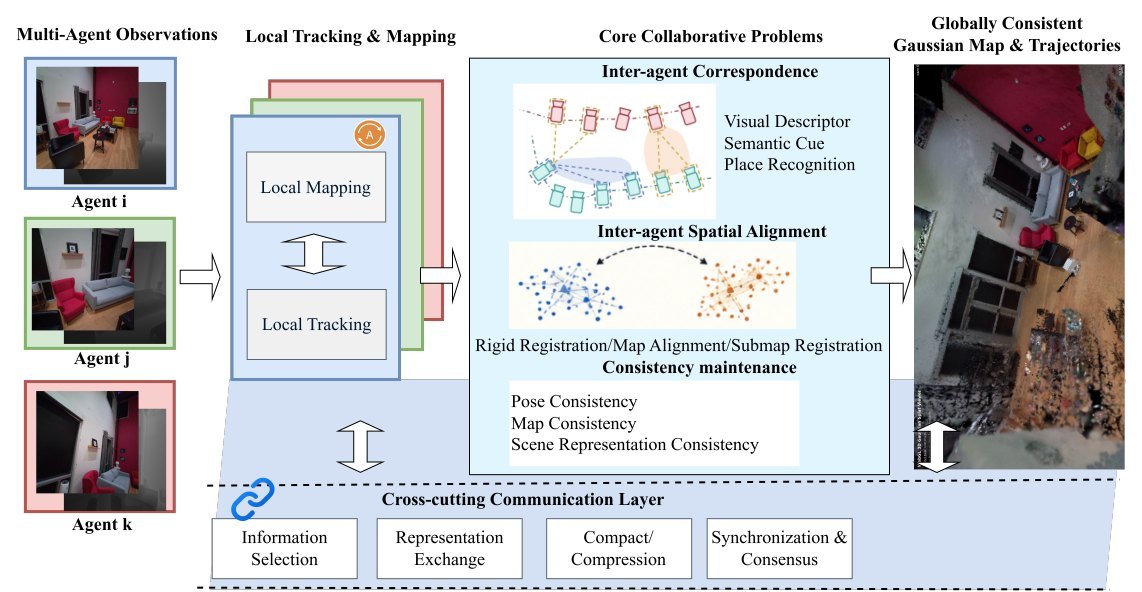
Correspondence, registration, consistency and communication, with the solution strategies used for each.
Datasets, metrics and results on ReplicaMultiAgent, plus seven open research questions.
02 · Architecture
Classic collaborative SLAM moved from centralized to distributed designs. Gaussian-splatting SLAM temporarily reverses that trend: most systems keep a server because 3DGS training and map fusion are heavy.
Centralized · most CoGS-SLAM today
Agents run tracking, local mapping and feature extraction. The server handles inter-agent loop closure, Gaussian-to-Gaussian registration, global map merging and pose-graph optimization.
e.g. CP-SLAM, MANG-SLAM, GRAND-SLAM, HAMMER, MAGiC-SLAM
Distributed · emerging
Each agent maps and tracks on its own and shares information peer to peer, reaching agreement through consensus (e.g. ADMM), distillation or distributed pose-graph optimization.
e.g. Di-NeRF, MNE-SLAM, MAC-Ego3D, CoMA-SLAM
03 · Core problems
From finding overlapping observations to building one consistent, scalable Gaussian map.
04 · Evolution
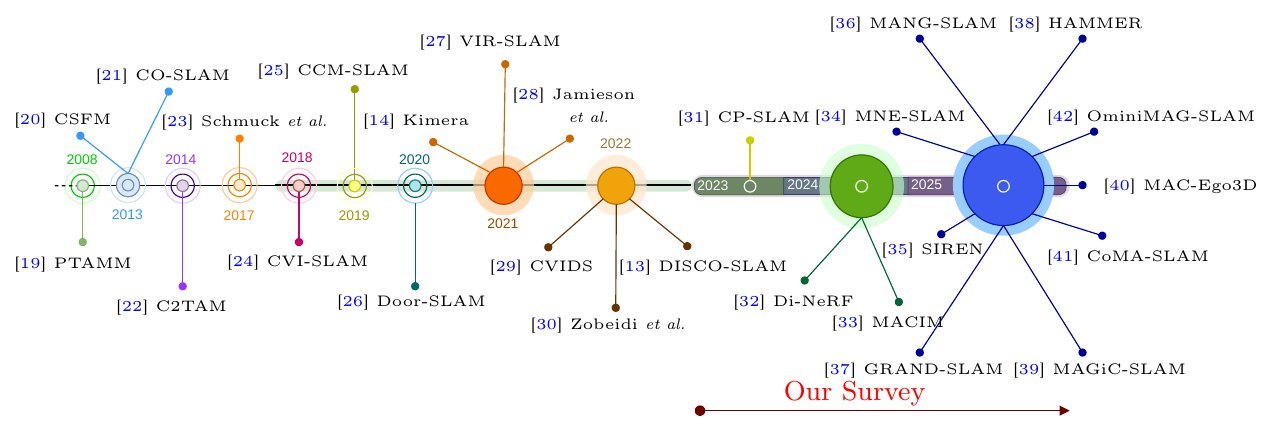
The milestones of Fig. 2 plus the systems compared in Tables 1–2, by year and map representation. Hover or tap a method to see its reference; click it to find it in the explorer.
05 · Explorer
Neural and Gaussian collaborative SLAM systems from Tables 1, 2, 4 and 5. Search, filter by representation or architecture, and click a row for the shared payload and reference. Press / to search.
| System | Year | Representation | Architecture | Consistency | Descriptor | Input | ATE (cm) | PSNR (dB) |
|---|
No system matches these filters.
06 · Benchmarks
Averages over the four ReplicaMultiAgent sequences (Office-0, Apartment-0, 1, 2), as reported in Tables 4 and 5. Systems without a reported average are left out.
| Dataset | Domain | Environment | Input | Originally multi-agent | Used by |
|---|
ReplicaMultiAgent is the closest thing to a common benchmark; real-world evaluation is still split across datasets, splits and protocols, which makes direct comparison hard.
07 · Applications
08 · Open questions
09 · Cite
@misc{nguyenxuan2025collaborative,
  title         = {Collaborative SLAM in the Era of 3D Gaussian Splatting: Architectures, Methods, and Future Directions},
  author        = {Nguyen Xuan, Phuc and Nguyen Canh, Thanh and Nguyen, Huu-Hung and Chong, Nak Young and HoangVan, Xiem},
  eprint        = {2510.23988},
  archivePrefix = {arXiv},
  year          = {2025}
}